

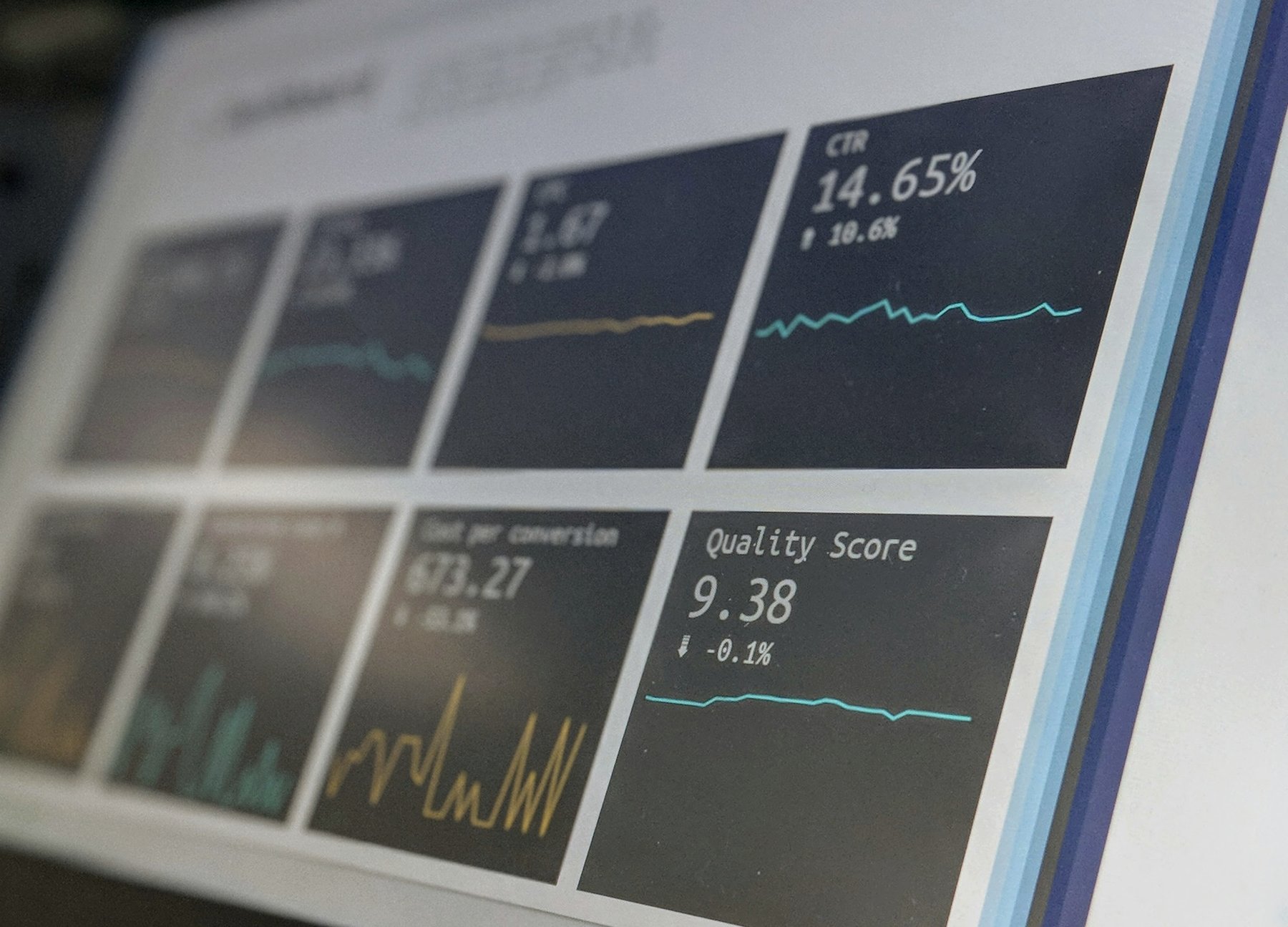
Every month, each UpManagement company reports five measures to the parent: uptime, occupancy, safety, margin, and capital spend against plan. The definitions are written down, the reporting week is fixed, and the numbers are reviewed by the same people every time. This is the least glamorous thing we do, and it is the reason the group can hold together.
A group of seven companies in seven sectors could easily become seven separate conversations, each with its own vocabulary, its own calendar and its own idea of what good looks like. A shared reporting standard is how we prevent that. This piece explains what the five measures are, how each company defines them, how the monthly review works and what the standard is deliberately not meant to do.
Why five, and why these five
Each measure answers a question that matters in every one of our sectors. Uptime asks whether the thing we operate is available when customers need it: a data hall, a tower, a classroom, a care team. Occupancy asks whether the capacity we built is being used. Safety asks whether people, residents and assets are protected. Margin asks whether the work pays for itself. Capital spend against plan asks whether we are building what we said we would build, at the cost we said it would take.
Five is a deliberate number. Fewer would leave out something every company has to get right. More would turn a common language into a reporting burden, and the measures would start to compete for attention. Five can be read on a single page, discussed in a single meeting and remembered by everyone in the room.
Together they cover the full life of an asset or a service:
- Capital spend against plan covers the build: is the money going where it was supposed to go?
- Uptime covers delivery: is the service available when it is needed?
- Occupancy covers demand: is the capacity being used?
- Safety covers the people and assets that make delivery possible.
- Margin covers whether the whole effort sustains itself.
Writing the definitions down
Not every measure means the same thing in every company. Occupancy in a senior living community is resident census; at a tower it is tenants per site; at a training center it is seats filled. But each company has to define its version, write it down and keep it stable. A definition that changes every quarter is not a measure.
A definition that changes every quarter is not a measure.
A written definition answers more than what is being counted. It states the source of the data, who is responsible for producing it, when the period closes and how unusual items are handled. For uptime at a data center, that might mean specifying which systems count, whether planned maintenance windows are excluded and how a partial outage is recorded. For safety at a senior living community, it might mean specifying which incidents are counted for residents and which for staff.
When a definition has to change, because a business has grown or a better data source has become available, the change is made openly. The old and new definitions are both recorded, the date of the change is noted, and where possible prior periods are restated so the trend remains comparable. What is not acceptable is a quiet adjustment that makes this month look better than last.
The same week, every month
The timing is as important as the content. When all seven companies report in the same week, problems surface while they are still small, and patterns across companies become visible. A cost overrun at one site can be compared with a similar project at another. A staffing issue in one market can be checked against the others. Nobody has to wait for a quarterly board deck to learn that something is off.
A fixed week also changes behavior inside each company. Finance teams can plan their close around it. Site leaders know when their numbers will be read. The shared-services platform, which runs finance, compliance, legal, technology and operations support across the group, can schedule its own work so that the data arrives clean and on time.
Consider a hypothetical to see why this matters. Two companies in the group are each building a project that depends on the same category of long-lead electrical equipment. If they report on different calendars, a supplier delay may show up in one company's numbers weeks before the other notices. Reporting in the same week puts both variances on the table at once, and the conversation about what to do can include everyone affected.
How a review runs
The monthly review is short and follows the same order every time. Each President presents the five measures for their company against plan and against the prior period. Variances are explained before they are asked about. Where a measure is off plan, the President states the cause, the action being taken and when the number is expected to recover.
Each company's President reports to the UpManagement Chief Operating Officer, and that line of accountability is visible in the review. The same reviewers read the numbers every month, which means they build a sense of each business over time. They notice when a margin has been drifting for three months even though no single month crossed a threshold. They notice when capital spend is on plan in total but the mix has changed.
The review ends with a short list of actions, each with an owner and a date. Those actions are the first thing discussed the following month. That closing step matters: a review that produces observations but no commitments becomes a ritual, and a ritual is easy to stop taking seriously. A review that produces commitments, and then checks them, keeps the standard tied to the work.
No one is surprised at the board table
The goal of a reporting standard is not paperwork. It is that no one is surprised. Presidents know exactly what they will be asked. The parent knows exactly what it will see. Bad news travels early because the format expects it. Over time, that creates a culture where the numbers are trusted, which means decisions can be made quickly.
Trust in the numbers is what allows the parent to give Presidents room to run their companies. When the reporting is consistent and honest, the parent does not need to second-guess operating decisions or ask for special reports. It can focus its attention where the numbers say attention is needed.
Bad news travels early because the format expects it.
Common mistakes we try to avoid
Reporting standards fail in predictable ways. We have designed ours with these failure modes in mind:
- Too many measures, so that none of them gets real attention and every review becomes a tour of a dashboard.
- Definitions that drift, so that a trend line reflects changes in counting rather than changes in the business.
- Reports that arrive late, so that by the time a problem is discussed it is already expensive.
- Numbers produced for the reviewer rather than for the business, which teaches teams to manage the report instead of the work.
- Reviews that punish bad news, which guarantees that bad news will arrive late or not at all.
What it does not do
Five measures do not run a business, and we do not pretend they do. Each company tracks far more detail in its own operations. The five are the common language between the companies and the parent, and the minimum that has to be true for a company to be on plan. Everything else is the President's to manage.
A data center operator watches power usage, cooling performance and customer tickets. A senior living operator watches staffing ratios, family satisfaction and care-plan compliance. A software business watches retention, pipeline and product usage. None of that detail is replaced by the five measures. The standard simply guarantees that, whatever else is happening, the parent and the company are always looking at the same core picture.
Companies in formation
The standard applies to every company in the group, including the three that are still being built. Bastion, Crucible and Guild are platforms in formation, and their approvals are not yet in place: facility clearance and related approvals for Bastion, investment adviser registration and other approvals for Crucible, and accreditation, program approvals and licenses for Guild.
For a company in formation, some measures are not yet meaningful. There is no occupancy to report before there is capacity to fill. What can be reported from the start is spend against plan, progress on the approval path and the definitions the company will use once it is operating. Writing those definitions before the first customer is part of the discipline. References to Crucible here are general information and are not an offer to sell, or a solicitation of an offer to buy, any security or investment product.
Why it holds the group together
Seven companies can share a parent without sharing much else. What makes UpManagement a group rather than a list is the shared platform and the shared standard. Every President reports the same five measures, in the same week, to the same reviewers, using definitions that do not move. That consistency is what lets each company keep its own focus and its own leadership while the group keeps the discipline consistent.
Published by UpManagement. This article is general information about the sectors in which the UpManagement companies operate. It is not legal, tax, investment or compliance advice, and it is not an offer to sell or a solicitation of an offer to buy any security. Where a company is described as a platform in formation, its approvals are not yet in place.